
Category


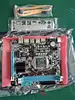

OEM Desktop computer mainboard LGA1155 socket new original motherboard
DJS-H61
minimum order:
1 set
Quantity:
- Item Condition:New
- Package:Yes
- Ports:SATA, USB 2.0, USB 3.0, HDMI
- With CPU:No
- Memory Bank:2 DDR3 DIMM
- CPU Type:Intel
- Chipset:H61, H61
- Maximum Ram Capacity:16GB
- Products Status:New
- Application:Desktop, Desktop
- Chipset Manufacturer:Intel
- Socket Type:Socket 1155, LGA1155
- Memory Type:DDR3, 2*DDR3DIMM
- Graphics Card Type:Integrated, Integrated-need CPU support
- Hard Drive Interface:SATA, SATA
- Brand Name:DJS
- Place of Origin:Guangdong, China
- Maximum Ram Ca:16GB
- FSB / HT:2400MHz
- Memory channel:Double
- Manufacturer:intel
- Certification:ce
- H61 motherboard is an entry-level chipset motherboard launched by Intel in 2011. Its core positioning is cost-effectiveness and basic functions. It is mainly equipped with second-generation/third-generation Core processors (LGA 1155 interface).
1. Core positioning: entry-level cost-effective choice
For users with limited budget, such as office consoles, home audio and video consoles or light game consoles.
The functions are streamlined, retaining only the core necessary interfaces without excessive expansion features to control costs.
2. Key hardware features
CPU interface: Only supports LGA 1155 interface processors, including second-generation Core i3/i5/i7 (Sandy Bridge) and third-generation Core i3/i5/i7 (Ivy Bridge), and is not compatible with CPUs with subsequent interfaces.
Memory support:
Only supports DDR3 memory, not DDR4 or higher.
Most models offer 2 memory slots, usually with a maximum capacity of 16GB (8GB per slot), although some early models only support single channel.
Storage interface:
Provides SATA II interfaces (transmission rate 3Gbps), usually 4-6 in number, to meet the basic connection needs of hard drives and optical drives.
The SATA III interface (6Gbps) is not supported and the full-speed performance of the solid-state drive (SSD) cannot be exerted.
Expansion slot:
Equipped with 1 PCI-E 2.0 x16 slot, which can connect independent graphics cards, but the bandwidth is x16, only supports the PCI-E 2.0 standard, and is not compatible with PCI-E 4.0/5.0 graphics cards (some new graphics cards are backward compatible, but the performance will be limited).
Usually equipped with 1-2 PCI-E x1 slots or traditional PCI slots for connecting network cards, sound cards and other devices.
3. Other features
Power supply design: It uses a basic power supply module, usually a 3-4 phase power supply, which can only stably support non-overclocked processors (such as i5-3470, i3-3240) and cannot meet the needs of high power consumption or overclocked CPUs.
Interface configuration:
The interfaces on the back are mainly basic, including USB 2.0 interfaces (usually 4-6), VGA/DVI video interfaces (some models have HDMI), PS/2 keyboard and mouse interfaces and RJ45 network ports.
Most models do not have a USB 3.0 interface and require an additional expansion card to be used.
Upgrade potential: The expansion capability is weak and cannot support new specifications of memory, storage or graphics cards. There is very little room for upgrades after long-term use.
Recommend Products
 The motherboard is where all the key hardware components of your computer, such as CPU, memory, and graphics card, come togetherH310Send Inquiry
 The motherboard is where all the key hardware components of your computer, such as CPU, memory, and graphics card, come togetherH81-2Send Inquiry
 H61P00000023Send Inquiry
 The motherboard is where all the key hardware components of your computer, such as CPU, memory, and graphics card, come togetherG41Send Inquiry
Send Message